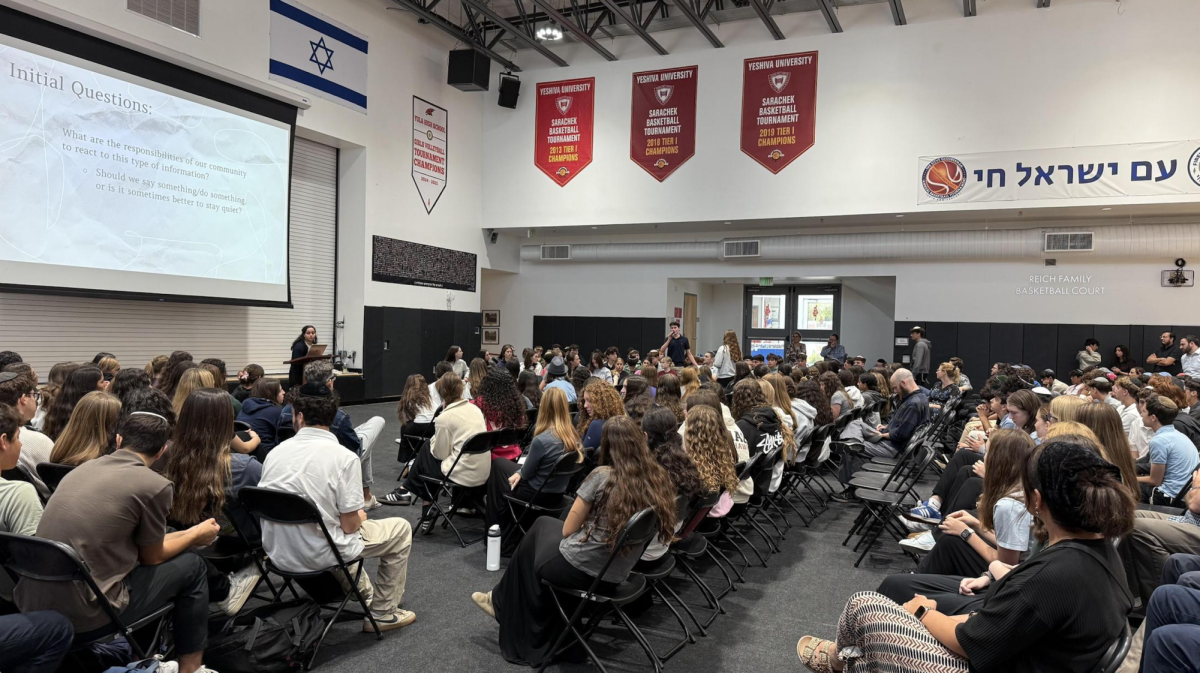
In March, when most of Shalhevet’s senior class flew to New York for Yeshiva University’s Red Sarachek basketball tournament, the competition brought together Jewish high school teams and their student fans from across the country. It was also an expression of school culture.
Student culture is not only defined by what happens in classrooms but also by a wide range of traditions that unfold across grades and social settings and even beyond school grounds. From school-wide events to informal gatherings, activities like Model Congress, Senior Assassin, Color War and sports team bonding events have become a consistent part of the student experience.
Students describe these moments and traditions as key moments of connection.
“That’s where you really get to know people outside of class,” said sophomore Aliza Terech. “It makes the school feel more connected.”
Less structured settings such as kumzitses (informal group singing gatherings often held by students) and out-of-school senior-freshman and boys tisches (casual hangouts centered around food and conversation) are spaces where students from different grades interact with each other and with school culture more informally.
“[They’re] not planned in the same way as other events, like school-run programs, but those smaller gatherings still end up meaning a lot,” said senior Benjamin Sztuden.
School spirit also plays a role. Events like Color War and Purim shpiels, along with student-produced videos and the Instagram college decisions page, contribute to a shared cultural language among students, including recurring chants, themed outfits and references to school videos that carry into daily conversations.
“People look forward to Color War every year, especially the competitions and team energy,” said junior David Dakar. “It is part of what makes the school experience unique.”
Some traditions have also drawn attention for their intensity or unpredictability, including large-scale chants, themed outfits, and high-energy student behavior during sports events.
“It’s something you hear about before you even experience it, especially the way people talk about the games,” said freshman Lenny Gerber.
“[It contributes to] a sense that there is always something going on, especially when everyone is involved at the same time,” freshman Elisha Frankel said.
Students say that the culture leads to a sense of continuity between grades. As these practices continue to evolve, students describe them less as isolated events and more as a developing culture passed from class to class.
“You grow up seeing it happen and then you eventually become part of it,” said senior Yonah Terech. “That is how it keeps going.”