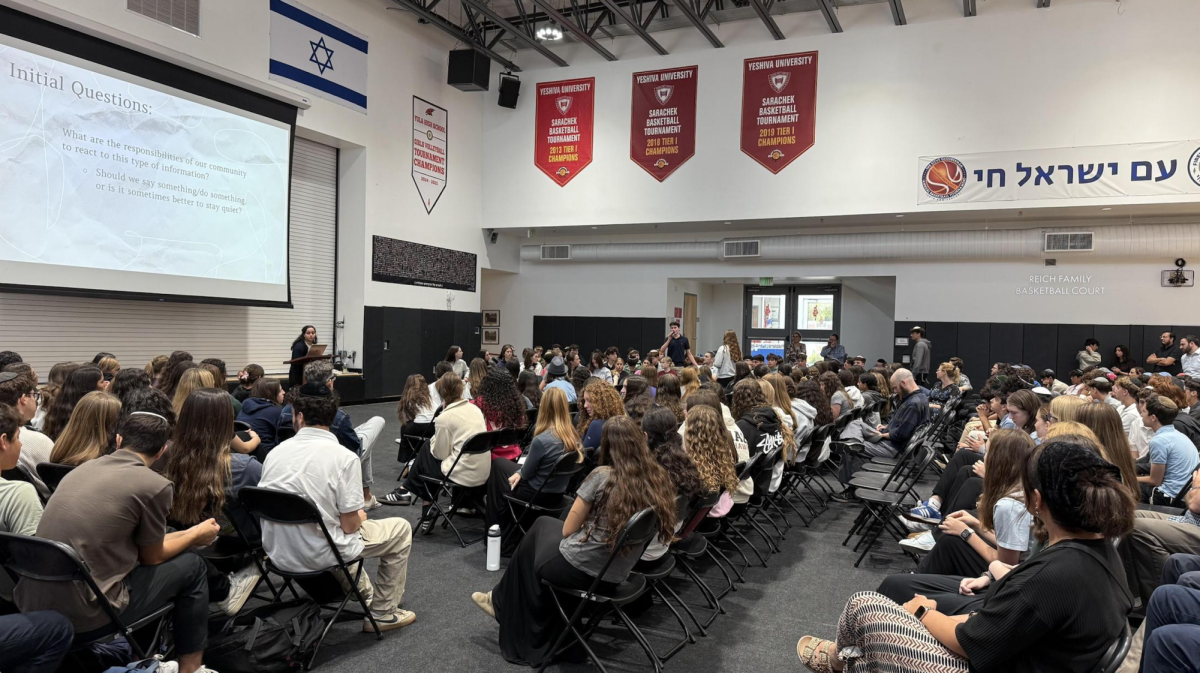
Bar Kupershtein, who survived the Hamas attacks of Oct. 7, 2023, was taken hostage by Hamas and remained in captivity for 738 days until he was freed in October 2025, spoke at a Shalhevet assembly in honor of Yom HaZikaron, Israel’s Memorial Day.
At the program, held in memory of the more than 25,000 people who had been killed in Israel’s wars and terror attacks, Mr. Kupershtein also showed drone footage mapping the Nova Music Festival site, as well as footage from Oct. 7 showing his own abduction by terrorists.
A former IDF commander, Mr. Kupershtein was serving as head of security at the Nova Music Festival on the morning of Oct. 7. He was responsible for 75 guards and the safety of 3,000 people.
“One day changed everything,” Mr. Kupershtein said, as he began a presentation about his experience in captivity. (The Boiling Point was not permitted to record the presentation, so most of Mr. Kupershtein’s account is presented in paraphrase.)
At 6:29 a.m. on Oct. 7, when Hamas rockets struck the Nova Festival, Mr. Kupershtein immediately told his security team the festival was over and ordered everyone to go home. But terrorists had blocked the surrounding kibbutzim, and cars were trapped. Mr. Kupershtein understood immediately that festival participants were in a “death trap”. He convinced the festival’s security director to open a secret emergency exit, allowing more than 2,000 people to escape. But he stayed.
With ambulances stuck in gridlock, Mr. Kupershtein drove back and forth through fire, loading injured people into his car and ferrying them to safety, again and again. He told his friend to stay behind and drove into the danger alone. When terrorists opened fire on his group of five people, he hid and waited through what he told students was 30 to 40 minutes of gunfire and screaming. He was the only one who survived. When it went quiet, he felt broken and alone, he said.
“Where is my army?” he remembered wondering at the time.
Then Kupershtein heard more screaming, witnessed more violence, and whispered the Shema, certain he was about to die. He and a friend hid in the bushes as terrorists passed. By 9 a.m. or 10 a.m., he was taken hostage along with three others and taken to Gaza.
In captivity, a terrorist looked at him and asked where his God was now. He didn’t have an answer, but in his mind, he told the students, he heard his mother’s voice tell him that God was testing him, and he needed to survive the test. He promised himself that he would do exactly that.
On day 47, Mr. Kupershtein and five other hostages were moved to a tunnel. He described the living conditions: on the ground, barely any food, dirty and salty water, a hole in the dirt for a bathroom and one shower a month. But on Shabbat, everything shifted for the group emotionally, he said. They sang Shalom Aleichem and made Kiddush over water.
“For us, this was a win,” he said.
One day, someone handed him a small transistor radio. By chance he was able to find a Hebrew station; two days later, he heard the broadcaster wish him a happy birthday, followed by his
mother’s voice on the broadcast, sending him her love. It wasn’t his mother he heard in that moment, he told Shalhevet students: it was God giving him back his hope.
When he finally came home, Mr. Kupershtein, now 24, had lost thirty kilos (about 66 pounds) during his captivity. One of his first acts was to put on his tallit and tefillin at the graves of those who didn’t make it, he said.
He considers the other hostages he was held with to be a second family, he said. They take trips together, stay in touch, and look out for one another.
“We have a WhatsApp,” he said.
Director of Teaching and Learning Rabbi David Stein had opened the assembly with a thought from the Torah: after the deaths of Aaron’s sons, God’s commandment was not to shut down or go quiet in grief, but to keep going, to keep working, to honor the fallen by continuing to live.
In closing, Mr. Kupershtein stressed the importance of unity.
“If everyone is together, nothing can happen to us. We need to be united,” he said.