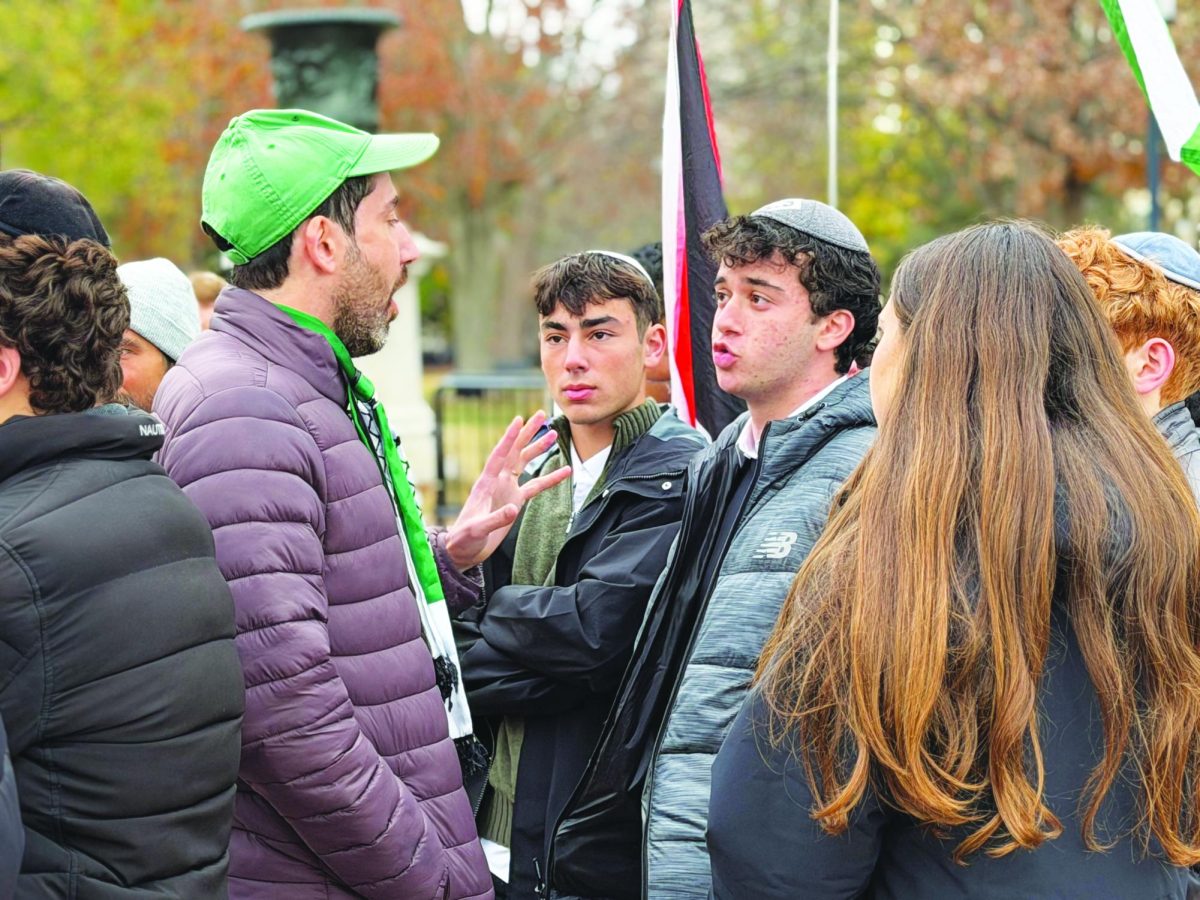
For their November Model Congress debate trip to Washington, DC, students had practiced arguments over healthcare, international relations, appropriations, taxes, commerce, education and more. But the most challenging argument waited for them after Shabbat morning davening when the team engaged with a group of approximately five pro-Palestinian protesters near the White House. The protesters were waving Palestinian flags and banners, and wearing keffiyehs and shirts reading “Stop Genocide in Gaza.”
The students asked two of the trip’s chaperones, Director of Teaching and Learning Rabbi David Stein and Director of Student Engagement, Mr. Tushar Dwivedi, if they could approach the protesters for a conversation. Rabbi Stein, who is also Shalhevet’s Israel Education teacher, was initially nervous, he said.
“These things could get a little contentious,” Rabbi Stein said.
He also wondered if students would be able to effectively engage with people who spend a lot of their time protesting. Ultimately, he realized that it would have felt wrong to walk away from the opportunity out of fear, Rabbi S said.
“This is what education is for,” Rabbi Stein said. “This is our job as educators, and this is an amazing opportunity.”
Mr. Dwivedi did not feel particularly nervous, but wanted to ensure the protesters were not unpredictable or aggressive, he said.
“Safety was at the forefront of our minds,” he said.
Mr. Dwivedi observed the situation and determined that the demonstrators were simply expressing their views legally in front of the White House, where security was high.
“This did not seem unsafe,” he said.
During the hour-long conversation between the students and the protesters, whose ages ranged from 30s to 60s, Rabbi Stein and Mr. Dwivedi observed the conversations from afar.
Rabbi Stein stayed back because he “wanted students to be the ones who engaged,” he said.
“I felt like if I were there, it would be really easy for me to give an answer,” he said. “The goal here is not debating protesters; it was for students to have experience standing up for [Israel] and experiencing what that’s like.”
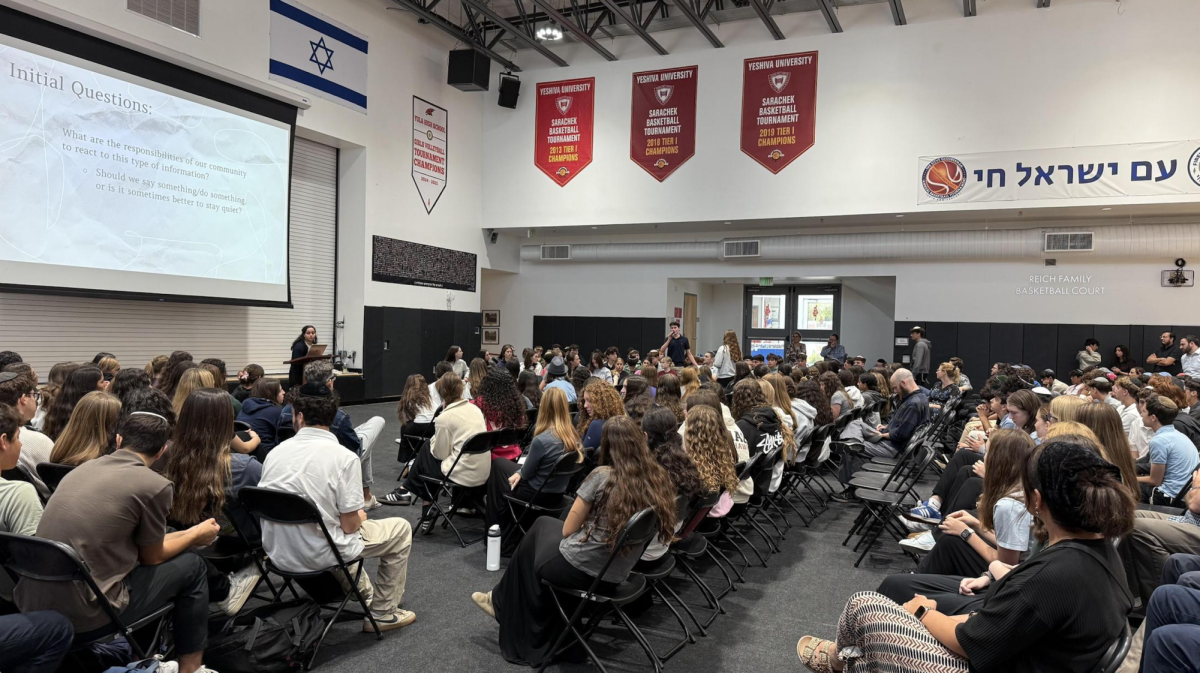
Because it was Shabbat, the students did not record the conversation. (Mr. Dwivedi, who is not Jewish or Shabbat observant, took a few photos of the encounter.)
In a December interview, students recalled the event, saying that they had engaged to understand the protestors’ motivation.
“I thought it would be interesting, and I’d have a cool conversation,” senior Alyssa Portnoy said. “But once I got into the conversation, my intention changed, and I wanted to change their perspective and gain perspective of my own.”
“I had never spoken to anyone or engaged in civic debate that way, and I was interested to see what points would come up,” Josh Elkus, a junior, said.
Josh recalled one memorable conversational moment with a protestor who self-identified as Jewish.
“[He] claimed that America was much more destructive and dangerous than the country of Iran, and [that] we need[ed] to find a way to tear down the American military government because it was so deeply flawed,” he said.
Another protester said Josh’s information on the conflict was fake.
“He was talking about Jews and Zionists, and [that] none of the beliefs [we had] were valid because any facts we brought up were immediately false [according to the protester],” Josh said.
The protester insisted that the information that Josh had was “…fed to me by sources that did not exist or were extremely biased or there was a cloth over our eyes” preventing students from having clear vision of the conflict.
When a protester argued that there could not be a Jewish-run government because Jews suppress Arabs, Alyssa responded.
“If we can’t have a Jewish-run government, then how can Jews feel safe anywhere they go?” she asked the protester. “The Jewish people experienced the Holocaust, and we have seen governments turn on Jews before. How can we ensure that a government won’t turn on Jews again?”
The man did not have an answer, she said, and began “stumbling over his words for the first time in the conversation.”
“I think the conversation was effective,” Alyssa said, “just the fact that we got him thinking about the need for a Jewish state and how there is more legitimacy in it than what he sees…was positive because it was calm and not a heated conversation. [We] just wanted to have a civilized conversation.”
Mr. Dwivedi described the exchange as respectful, like a Town Hall where people strongly disagree but still listen to one another. He appreciated that both sides engaged thoughtfully, and said the students did a good job hearing the protesters out.
Josh said he was glad the conversation happened, but was “simultaneously in shock about the beliefs that some people could validate for themselves.”
“I think it was effective not because we changed anybody’s mind or they changed any of our minds, but I think it was an important discussion to have,” Josh said. “First of all, to show that Jews and Zionists are not very aggressive people who just immediately shut down all opposing political views, and also to evaluate other people’s opinions, which I think is important in political discourse.”
“I was very, very proud of our students for not only feeling like they have a strong opinion and belief about Israel,” Rabbi Stein said, “[…but] for feeling confident enough to speak their mind and their opinion and move their message with respect.”
After conversing with the group, the protester who had identified himself as Jewish told them that he lives in Long Beach, California.
“He said that whenever we are in Long Beach, we should go to his parents for Shabbos,” Alyssa said.